B2B Content Marketing Strategy Checklist: 8 Steps to Build Content That Drives Pipeline
A systematic approach to building a content foundation that supports your GTM motion and drives measurable pipeline impact for B2B SaaS, AI, and tech companies.
TL;DR
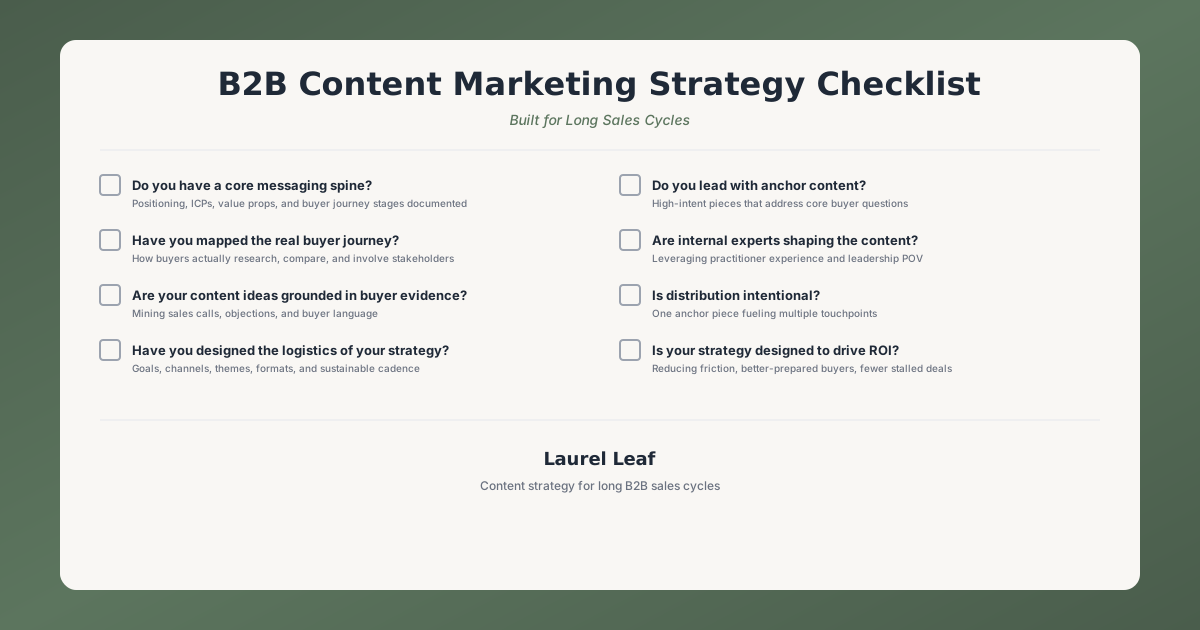
This B2B content marketing strategy checklist covers the 8 essential steps: build a core messaging spine that documents your positioning, ICPs, and value props. Map content to specific buyer questions at each journey stage—not arbitrary funnel stages. Start with one high-intent anchor piece, repurpose it into 5-7 assets, then track content-influenced pipeline instead of just pageviews. Without alignment on these fundamentals, your content becomes random activity instead of strategic execution.
In this article
Most B2B marketing teams are busy. The calendar's packed, assets are shipping, and everyone's working on five things at once. But are you all running in the same direction?
Our B2B content marketing strategy checklist gives you a systematic approach to building a foundation that supports your GTM motion. It's designed for marketing leaders at B2B SaaS, AI, and tech companies who need a content engine that supports long sales cycles and drives measurable pipeline impact.
Without a documented B2B content marketing strategy, everything from ideation to reporting becomes much harder. And in complex B2B industries where sales cycles can stretch on for months, this misalignment can be the difference between 'deal lost' and 'deal won'.
1. Do you have a core messaging spine?
No B2B content marketing strategy checklist would be complete without this step. Because without a shared narrative, marketing, sales, and leadership are all telling a different story.
Your website says one thing, sales decks say another, and buyers are getting mixed signals at every touchpoint. This kills customer trust faster than anything else.
A core brand messaging framework creates a single source of truth that defines:
Positioning & narrative
How you frame the problem and your unique approach to solving it
ICPs & buying committees
Who's involved in buying decisions and what each person cares about
Value propositions
Why buyers should choose you over alternatives
Proof points
Testimonials, case studies, and first-party data that backs up your claims
Step 1 Checklist
- ☐ Audit team alignment by asking three different people: "Who is our content for and what problem does it solve?"
- ☐ Document your positioning, ICPs, value props, proof points, and buyer journey in a single shared framework
- ☐ Create a one-page message map that everyone—from product to sales to content—can use
2. Have you mapped your actual buyer journey?
Days average B2B sales cycle
From initial contact to closing — Source
During that time, prospects consume several pieces of content, involve multiple stakeholders, and juggle shifting priorities. Traditional funnel thinking fails here—it assumes buyers move neatly from stage to stage.
In Reality, Stakeholders Ask Different Questions
- Your CISO is asking "how does this work with our stack?"
- Your CFO is asking "what's the TCO and payback logic?"
- RevOps wants to know "how long will this take to implement?"
Content mapped to the buyer journey answers the specific questions each stakeholder asks at each stage. It's not about selling your solution—it's about helping teams make the best decision with bottom-of-funnel content that supports evaluation.
Step 2 Checklist
- ☐ Map content to three critical questions: What triggers prospects to research? Who do they compare you against? What objections stall deals?
- ☐ Identify stakeholders involved in buying decisions and document what each role cares about most
- ☐ Before creating content, ask: Does this answer a specific buyer question at a specific stage?
3. Are your content ideas rooted in buyer evidence?
Great content doesn't come from brainstorming alone. Your strongest topics are based on actual customer conversations, not just broad assumptions.
Sales calls and deal reviews
What questions come up in every demo? What objections stall deals? What comparisons do buyers ask about repeatedly?
Actual buyer language
How do prospects describe their problem when they search or ask LLMs? What terminology do they use internally?
High-performing content
What assets did sales share that helped close? What blog posts do ideal customers reference in conversations?
Step 3 Checklist
- ☐ Review the last 10 sales calls and extract the top 5 repeated questions or objections
- ☐ Ask your sales team: "What questions do buyers ask that we don't have good answers for?"
- ☐ Audit your content calendar: How many topics are backed by buyer evidence vs. assumptions?
4. Have you clarified content logistics?
of B2B marketers rate their strategy as only 'moderately effective'
Content Marketing Institute—lack of clear goals cited as main reason
Without clear goals, channels, themes, and cadence, content becomes random activity instead of strategic execution. Before you write a single word, clarify your content logistics by answering these questions (we follow Lee Densmer's 3×5 framework):
Define goals
Support pipeline? Enable sales? Build category authority? Pick 3 primary goals
Identify channels
Search? LinkedIn? Email? Reddit? Prioritize top 3 where your ICP makes decisions
Align on themes
Build 3 content pillars around repeated buyer questions and objections
Set cadence
What's sustainable? Consistency beats volume every time
Step 4 Checklist
- ☐ Prioritize 3 content goals for this quarter and communicate to everyone involved
- ☐ Identify 3 channels where your ICP evaluates solutions
- ☐ Establish a realistic cadence your team can maintain for 90 days
5. Do you lead with anchor content?
This is often the turning point in any B2B content marketing strategy checklist. Instead of chasing volume on every channel, start with one strong, high-intent anchor piece that answers a core buyer question. Then redistribute that content across your core channels.
Generic Content vs. Anchor Content
Generic Content:
- • Hopes someone finds it useful
- • Published once and forgotten
- • Measures pageviews
Anchor Content:
- • Built around specific buyer questions
- • Repurposed into 5-7 assets
- • Measures pipeline influence
Step 5 Checklist
- ☐ Identify one high-intent topic buyers search for when evaluating solutions
- ☐ Validate against actual buyer search behavior and LLM queries
- ☐ Plan repurposing into 5-7 assets before moving to the next topic
6. Are internal experts shaping your content?
The best B2B content (not to mention the strongest startup positioning) comes from real practitioner experience and a real POV. Internal SMEs hold insights your buyers trust and competitors can't replicate.
SME insights
Product leaders know technical nuances. CS teams hear objections. Engineering understands implementation challenges.
Thought leadership
Buyers want to do business with people, not corporate entities. Personal LinkedIn amplifies reach.
Step 6 Checklist
- ☐ Identify 2-3 internal SMEs who can provide unique insights
- ☐ Record SME interviews to fuel content creation
- ☐ Activate at least one thought leader on personal LinkedIn
7. Is distribution intentional?
Publishing once and hoping it works is the classic content mistake. One strong piece should fuel multiple touchpoints across channels where decisions happen.
Distribution Channels to Consider
- ✓ Multi-channel deployment: Website/SEO, email, LinkedIn (personal + brand), sales enablement, paid, partners
- ✓ Strategic gating: Only gate extremely valuable pieces. Educational content stays open to build trust.
- ✓ Usage tracking: Monitor what sales teams share and which pieces buyers engage with most
Step 7 Checklist
- ☐ Plan distribution across at least 3 channels for every anchor piece
- ☐ Track which content sales actually uses in deals
- ☐ Schedule 6-month refresh for high-performing content
8. Does your strategy aim for ROI?
The final step in this B2B content marketing strategy checklist is often the most overlooked. When leadership asks "Is content helping revenue?" most teams respond with pageviews. But content ROI comes from reducing friction in the buying process, not just increasing traffic.
Vanity Metrics vs. Better Alternatives
Step 8 Checklist
- ☐ Define 3 metrics that show content moving buyers through stages
- ☐ Set up tracking for content-influenced pipeline
- ☐ Ask sales monthly: "Which content helped move deals forward?"
Ready to put this B2B content marketing strategy checklist into action? We can help you build a content engine that drives pipeline.
Let's talkFrequently Asked Questions

Caitlin McCarthy
Messaging and Content Strategist at Laurel Leaf