Startup Positioning: Why Your Startup Needs a Point of View (Not Just a Product)
Most companies stop at features, benefits, or ROI stats. But a POV goes beyond that. It's not just what your product does—it's how you see the problem. And that perspective is what makes your story stick.
TL;DR Key Takeaways
Effective startup positioning creates the "they get it" moment and is often the first thing your audience notices. Strong startup positioning must be unique (competitors aren't saying it) and relevant (your ICP cares). Real POV marketing disqualifies wrong-fit buyers—it's filtering, not just persuading. When competitors copy your startup positioning, evolve rather than defend.
Let's talk about something that often gets overlooked when it comes to startup positioning and messaging for your company.
It's usually the last thing brands think about—but often the first thing your audience notices. It's what creates that "wait, they get it" moment in someone's head. And for startups in crowded markets, it's a non-negotiable.
That thing? Your point of view.
How to position your startup with a POV
That's the question at the heart of effective startup positioning.
Take our client, Autoblocks AI. On the surface: another AI agent testing platform. But underneath: a radically different take on what matters when shipping agents.
The Autoblocks Insight
In a market obsessed with going fast, they saw the bigger risk: shipping broken AI agents.
That insight—that shipping reliably matters more than shipping fast—wasn't just messaging. It was the company's advantage.
Our job was to turn it into a POV that could sell.
✨ The POV That Sells
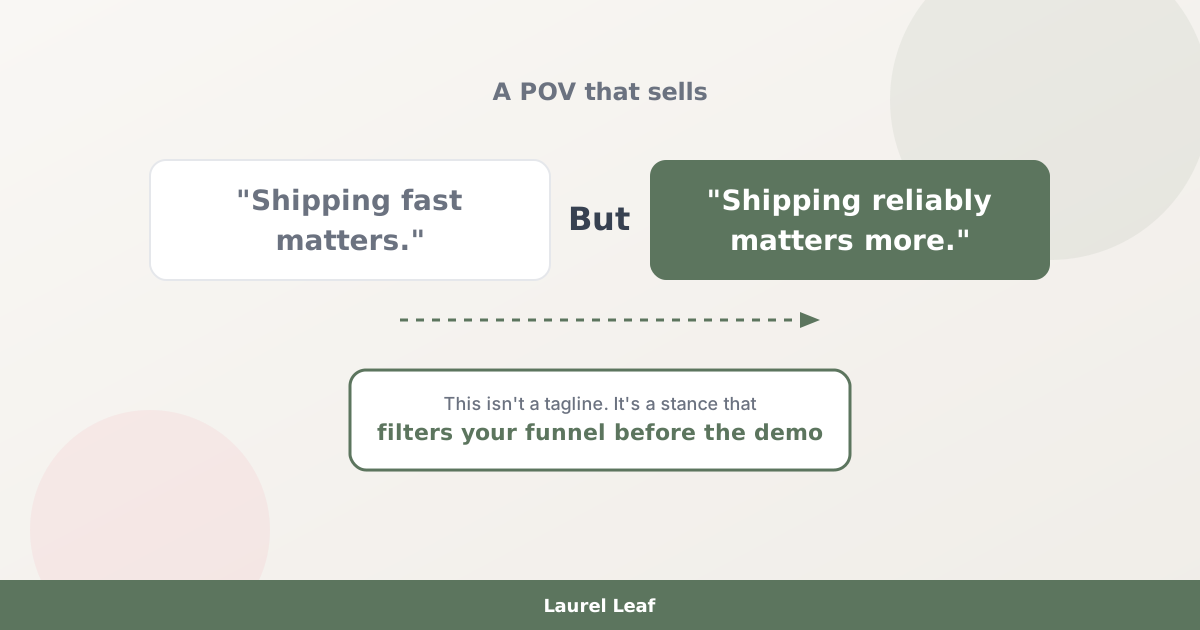
"Shipping fast matters. But shipping reliably matters more."
Simple. Clear. Sharp. Not a tagline. But a stance.
Why startup positioning needs more than features
Startup messaging without a point of view gets you to Step 1. Technically valuable, but completely unmarketable.
And yet, that's where most companies stop.
They default to features. Or founder origin stories. Or vague "change the world" fluff.
They skip the part that actually does the work: Saying something specific about the world you're building for your customers.
⚠️ Where Startup Messaging Goes Wrong
- They think their POV has to be world-changing. It doesn't. Most compelling positioning is grounded—not grandiose.
- They promise the impossible. The best POVs finally name the real problem your ICP deals with daily.
- They try to appeal to everyone. If your messaging attracts everyone, it resonates with no one.
What made Autoblocks' stance powerful wasn't that it was revolutionary. It was that it reflected a real tradeoff every AI team building real-world workflows deals with: velocity vs. reliability.
Based on the three components of effective positioning, strong startup messaging must be:
Unique. Not in the "nobody's ever said this before" way—but in the "none of our competitors are saying it like this" way.
And relevant. Not to the total addressable market. But to your ICP. The buyer with urgency. The one who needs a new perspective on the problem and would be a fool not to buy.
Founder POV vs. brand positioning strategy
Sometimes, the founder already has a POV. And that's a great starting point.
But it doesn't always translate directly into the brand.
Founder POV
Personal. Shaped by their experiences and beliefs. Focused on long-term vision, technical elegance, or the ethical "why."
Brand Positioning
Market-aligned. Needs to match what your ICP is ready to hear. Focused on why this product matters right now.
Founders want to talk about the long-term vision, the technical elegance, or the ethical "why." But if the customer just wants a reliable way to test AI agents before they break production, that's what the brand needs to focus on.
That doesn't mean you should ignore the founder's POV—you just need to channel it into something customers can act on.
💡 The Key Insight
Your brand positioning strategy should do one thing really well: Clarify why this product matters, right now, to the right people.
The founder POV can live alongside it—in interviews, thought leadership, fundraising decks. But the brand positioning strategy is what connects with customers right now.
Point of view marketing vs. traditional pitching
Here's where startup positioning goes wrong: They think point of view marketing means positioning themselves as better.
But real startup messaging disqualifies. It alienates the wrong buyers. It draws a hard line.
If you're optimizing for hackathon speed, Autoblocks isn't for you. If you're deploying agents in high-stakes environments where breaking things is a non-starter? Autoblocks is your tool.
That's not a pitch. That's filtering your funnel before the demo request.
How to develop your startup's POV
Point of view marketing is research work. But not in the traditional "customer discovery" sense.
To find Autoblocks' edge, we looked at:
- What their competitors were saying (and what they weren't)
- What their best-fit buyers actually cared about
- What the founder believed—but hadn't yet articulated
We weren't chasing virality for the sake of it. We were mining for fit.
💡 Where Strong POVs Come From
The strongest startup positioning often comes from overlooked places:
- • An offhand comment in a podcast
- • A support ticket from the right customer
- • A tension between what the market expects and what the product actually delivers
Why startup positioning strategies fail
Similar to niching down on an ICP, claiming a point of view is hard because it forces decision-making and saying no to things.
You can't say everything to everyone. You can't be the fastest and the safest and the cheapest and the smartest.
You have to choose.
Most companies avoid that choice. They stick with boilerplate startup messaging: "We help teams build better AI agents."
Cool. So does everyone else.
Autoblocks chose trust. They didn't try to sound smarter. They chose to sound more sane in a sea of hype.
Protecting your startup's positioning advantage
You get your startup positioning right. It hits. It resonates. It converts.
Then others in your category start saying the same thing.
Instead of panicking, stop. Breathe. And take the time to evolve.
Elevate to Principle
Move from "we help you ship reliably" to a higher-order belief: "Reliability isn't a tradeoff. It's infrastructure."
Show Proof
Anyone can say it. Only you can show how you deliver it—through your product, your process, your customers.
Differentiate on How
What do you do differently under the hood? Your test coverage? Your risk model? Your integrations?
Advance Your Positioning
While others echo your last stance, you're already onto the next one. That's what thought leadership actually means.
You don't defend your startup positioning. You lead with it. And when others catch up, you evolve it.
Building lasting startup positioning
If you're an AI or SaaS startup or even an agency—it doesn't matter—your edge won't come from another service offering or product feature.
It'll come from how you see the problem differently.
That's the POV in your startup positioning.
And if it's not showing up in your startup positioning and messaging, your buyers might not see what makes you worth choosing.
Ready to nail your startup positioning? We help startups craft clear, compelling positioning that cuts through the noise.
Book a free consultationFrequently Asked Questions

Defne Gencler
Founder at Laurel Leaf
Hey my name is Defne and I'm the Founder of Laurel Leaf. I can help you with your positioning, messaging, and content.