How to Build a B2B Content Marketing Strategy for Long Sales Cycles
Most B2B content marketing strategies fail for one simple reason: they aren't built for long sales cycles. Here's the seven-step framework that actually works.
TL;DR Key Takeaways
A successful B2B content marketing strategy must account for 3-7 content pieces buyers consume before reaching out. Traditional funnel-based content fails because B2B buyers don't move linearly—they loop back constantly. Content's real job in long cycles is to hold the narrative together when sales isn't in the room. Start with positioning, map your buying committee, and measure influence over attribution.
In this article
In SaaS, AI, health tech, infrastructure, and other complex B2B markets, buying decisions don't happen after one blog post or a single demo. They unfold over months, involve multiple stakeholders, and stall easily when clarity or momentum drops.
Why do most strategies fail?
There's a common belief that the role of content is to create an immediate conversion. But that's not how people behave in B2B buying cycles.
Your prospects don't see a single post or a single ad and decide to make a purchase on the spot. They take time to make decisions. They go back and forth, weigh their options, and loop in stakeholders.
And during this time:
- New people enter the conversation
- Earlier discussions are forgotten or misinterpreted
- The original problem loses urgency
- Internal alignment weakens or priorities shift
- Months pass between meetings, demos, and follow-ups
Content pieces consumed
Before B2B prospects reach out to vendors — Source
Unfortunately, most content marketing programs aren't built for this reality. They optimize for first touch when prospects consume 3-7 content pieces before reaching out.
Traditional advice falls flat
Most marketing advice is written for short sales cycles and solo decision-makers. But B2B doesn't work that way. Here are five pieces of traditional content advice and why they fail:
⚠️ Common Advice That Backfires
- "Create content for each funnel stage" — But B2B buyers don't move linearly; they loop back constantly.
- "Focus on SEO keywords" — But long-cycle buyers need answers to questions they can't even articulate yet.
- "Gate your best content" — But buying committees share internally; gates create friction.
- "Measure success by MQLs" — But MQLs don't reflect deal influence over months.
- "Publish consistently" — But volume without strategy just creates noise.
- "Speak to one buyer persona" — But during long B2B sales cycles, you're speaking to a team.
Shift to a holistic content engine
Ask most B2B teams about their B2B content marketing strategy and you'll hear:
- "We have a content calendar"
- "We're investing in SEO"
- "Our execs are doing thought leadership"
But none of this answers the fundamental question: How does your content support a 6-12 month buying journey?
💡 The Real Job of Content
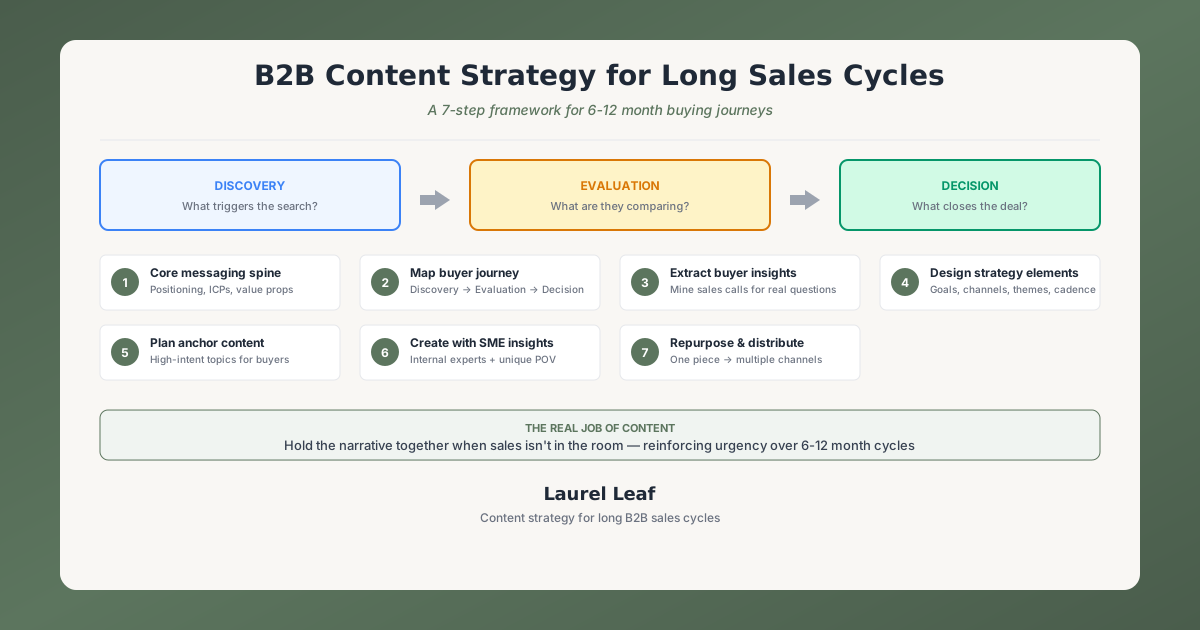
When deals stretch over months, content's real job is to hold the narrative together—reinforcing urgency, re-aligning stakeholders, and keeping momentum alive when sales isn't in the room.
How to build a B2B content marketing strategy for long sales cycles
An effective B2B content marketing strategy designed for long sales cycles starts with a system built on seven connected steps. Content for long B2B sales cycles should be focused around common questions that keep reoccurring.
Step 1: Start with a core messaging spine
Every effective content strategy starts here. A core messaging framework creates a shared source of truth that defines:
Positioning & narrative
How you frame the problem and your unique approach
ICPs & buying committees
Who's involved in decisions and what each person cares about
Value propositions
Why buyers should choose you over alternatives
Proof points
Evidence that backs up your claims
Buyer journey stages
Discovery → Evaluation → Decision
Without this alignment between teams, your content marketing program can't scale. Everyone ends up doing their own thing and telling prospects their own story.
⚠️ When Inconsistency Kills Deals
When deals stretch over 6-12 months, inconsistency is fatal. If your website says one thing, your sales deck says another, and your LinkedIn posts contradict both, buyers won't know what to believe.
Step 2: Map out the buyer journey
At its simplest, a strong content marketing funnel maps content to stages of the buyer journey:
Discovery
What triggers a prospect to look for a solution like yours? What channels do they turn to?
Evaluation
What solutions are they comparing you against? What factors do they consider?
Decision
What messages reinforce confidence and reduce risk? What do they need to know?
While this 'funnel' simplifies the buyer journey, it's not linear. Especially in B2B. Content supporting long sales cycles answers questions that come up throughout this process.
For teams looking to directly impact revenue, investing heavily in bottom-of-funnel (BOFU) content strategy can deliver the highest return.
Step 3: Extract buyer insights
Content can't be created out of thin air. It has to start with your prospects and customers.
Start by mining sales calls to identify:
Repeated buyer questions
What do prospects ask in every demo? What questions come up repeatedly?
Objections that stall deals
What concerns are stalling decisions? What hesitations keep surfacing?
Language buyers use internally
How do they identify and describe their problem? What terminology do they use?
These insights inform content topics buyers actually care about and reflect the questions buyers ask LLMs and search engines.
Months prospects can go dark
While they research independently and build their business case without vendor involvement
Content addressing their actual questions (surfaced from sales call insights) keeps them engaged and helps them sell your solution internally.
Step 4: Design the core elements of your B2B content marketing strategy
Once you've laid the groundwork for where your content comes from, you can start building a system for content operations. Before you plan specific pieces, you need to answer a few unsexy but critical questions based on everything above:
Define your goals
What is content supposed to do this quarter?
- • Support pipeline?
- • Enable sales?
- • Build category authority?
- • Shorten sales cycles?
Identify your core channels
Where do your buyers spend time during evaluation?
- • Search?
- • LinkedIn?
- • Email / Reddit / Niche communities?
Align on core themes & pillars
What topics should you build content around?
- • Desired outcomes from sales calls
- • Problems needing reassurance
- • Comparisons & misconceptions
Formats & cadence
What's sustainable for your team?
- • Formats that fit bandwidth
- • Consistency beats volume
- • Stay top of mind without burnout
💡 From Ideas to System
This step turns strategy into a real operating model. It's the point where content stops being "ideas" and starts becoming a system.
Step 5: Plan your anchor content
Once you've identified your core topics, start with a core anchor piece. Ideally this will be a topic that targets high-intent buyers and answers the core questions they have (and might be asking LLMs).
If you're incorporating SEO, see which keywords match these topics and intent (this way you're making your buyers and search engines happy!).
Step 6: Create your anchor content with internal insights
The key to creating content that machines (and competitors) can't replicate? Leverage unique insights from your internal experts and thought leaders.
Anyone can write a blog post or email sequence these days. But truly effective content that gets cited, trusted, and closes deals contains experiences, insights, and POV that only your internal experts have.
Internal expert content differentiates you because it addresses problems most competitors ignore with perspectives they can't replicate.
Pro tip
If your experts are also thought leaders or open to being public, record these interviews and use them for social clips. Videos go a long way for building trust and pipeline.
If your internal experts aren't your best public-facing options, identify someone internally to post on behalf of the company. As is commonly known by now, personal accounts perform a lot better on LinkedIn than company pages.
Step 7: Repurpose and distribute strategically
Because you're starting with a rich anchor piece based on unique insights, you now have a wealth of material to repurpose from.
Your core anchor piece can be broken down into a set of smaller content pieces and different formats. And you can use it to inform your distribution strategy—since you can share or publish your anchor piece and repurposed items across your:
Distribution Channels to Activate
- ✓ Website: SEO-optimized blog, resource hub, landing pages
- ✓ Email: Newsletter, nurture sequences, sales follow-ups
- ✓ Social: Founder, exec, or company LinkedIn pages
- ✓ Ads: LinkedIn thought leader ads, retargeting
- ✓ Sales: Direct conversations, deal support materials
This is what we call distribution with intent. It's a lot more effective and efficient than treating each channel as a silo and posting just for the sake of it.
👤 People Over Pages
Activate customer-facing leaders to post on their personal accounts. Personal pages outperform company accounts—people want to do business with people, not corporate accounts.
How to implement your B2B content marketing strategy (without burning out)
A great content strategy doesn't need to be complicated, it just needs to be structured. Here's the 90-day roadmap we use with clients to build clarity, credibility, and momentum:
Foundation & Launch
Week 1-2: Strategy
- • Define positioning, ICPs, value props
- • Map buyer journey + sales call insights
- • Set goals using 3×5 framework
Week 3-4: Engine
- • Run SME interview
- • Create core anchor piece
- • Repurpose + distribute
Scale & Optimize
- • Continue content engine (SME interviews, anchor pieces, repurposing)
- • Track performance metrics
- • Promote high-performing posts via LinkedIn thought leader ads
- • Refine based on engagement data
Connect to Pipeline
- • Continue content engine
- • Identify target accounts engaging on LinkedIn
- • Send sales team relevant lead lists
- • Track performance & ROI
- • Run quarterly strategy review
How to track your content marketing performance over time
Long sales cycles can make measuring content reporting tricky. As one marketer shared in a recent r/b2bmarketing thread: "Deals take months, sometimes quarters, but reporting expectations haven't slowed down. Marketers are being pushed to show impact earlier in the funnel without damaging long-term pipeline health."
Instead of focusing on vanity metrics like impressions and comments—which are useful for gauging engagement but don't directly tie to business outcomes—the best method is to focus on impact on revenue.
The key is understanding how metrics ladder up: leading indicators (like content engagement and contact form submissions) feed into lead quality and velocity (SQLs and conversion rates), which ultimately drive sales pipeline metrics (opportunities, deal size, and closed revenue).
Below are some ways to track this progression:
Leading Indicators
- • Contact form submissions from target accounts
- • RFP/proposal requests
- • Discovery call bookings
- • Engagement with high-intent content
Lead Quality & Velocity
- • Monthly traffic → SQLs
- • SQL to opportunity conversion
- • Time from first touch to SQL
- • Lead source attribution
Sales Pipeline Metrics
- • Opportunity to closed-won rate
- • Average deal size by source
- • Sales cycle length
- • Pipeline value monthly
- • Win rate by lead source
Common mistakes to avoid when building out your content strategy and engine
If you've gotten this far and you'd like to apply the steps in our framework, be sure to avoid common pitfalls that teams fall into when setting this up themselves:
- ❌ Skipping the strategic alignment: Without a shared narrative, every department (and channel) ends up telling a different story
- ❌ Creating content without buyer insights: Sales calls contain the questions buyers actually ask when evaluating your solution
- ❌ Building for traffic instead of pipeline: Traffic doesn't close deals, informed buyers do
- ❌ Executing on content before defining strategy: Strategy first, execution second
- ❌ Creating anchor content without internal experts: Generic content doesn't differentiate. Your internal experts are the wealth of knowledge that your buyers want to hear from
- ❌ Publishing without repurposing: Your anchor piece should feed weeks of distribution
What changes when your B2B content marketing strategy starts to work
A great B2B content marketing strategy is designed to reduce friction for prospects and internal teams. It:
- ✓ Reinforces a shared narrative across channels
- ✓ Supports evaluation and decision stages over time
- ✓ Compounds insight and point of view
- ✓ Makes sales conversations easier, not heavier
This is where content marketing ROI actually comes from. Not traffic spikes, but fewer stalled deals and better-prepared buyers.
When teams adopt a system-led approach, they consistently see:
Better sales conversations
More focused, less re-educating
Higher-quality prospects
Better-prepared buyers entering the funnel
Content reused everywhere
Marketing, sales, and leadership aligned
Improved ROI
Without relying on volume
Over time, this approach compounds. The same core insights fuel marketing, sales, and leadership communication. Content gets repurposed instead of created in silos. Sales conversations become more focused. Misaligned buyers self-select out. And teams spend less effort re-educating and more time advancing real opportunities.
That's where content ROI comes from in B2B: not more content, but fewer stalled deals, better-prepared buyers, and a system that supports revenue long after publishing.
Need help building out and executing on your B2B content marketing strategy?
If this article resonated, there's a good chance your team isn't struggling with effort but with structure.
Most teams we work with already have content in motion, smart people involved, and a sense that "this should be working better than it is."
What they're missing is a connected system: One that aligns messaging, content, and sales around the same buyer reality.
At Laurel Leaf, we help B2B teams:
- Clarify their messaging before scaling output
- Design content around real buyer questions
- Build B2B content marketing strategies that support long sales cycles—not just traffic goals
If you want to sanity-check whether your content is actually supporting your funnel, the easiest next step is understanding how we approach it.
Ready to build a B2B content marketing strategy for long sales cycles?
Frequently Asked Questions

Caitlin McCarthy
Messaging and Content Strategist at Laurel Leaf