BOFU Content Best Practices: How To Build Content That Converts
With AI search tools swallowing top-of-funnel visibility, BOFU content is where the real conversions happen. These BOFU content best practices will help you create bottom-of-funnel content that converts at 5-10%+.
TL;DR
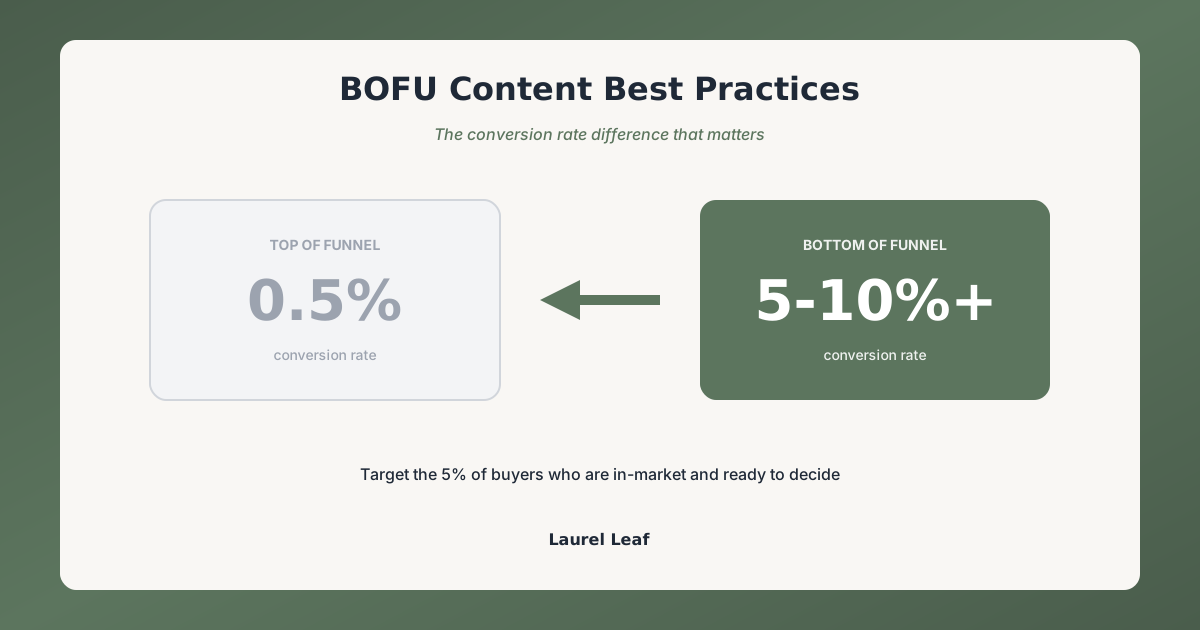
These BOFU content best practices target the 5% of B2B buyers who are in-market at any given time (the 95:5 rule), with conversion rates of 5-10%+ compared to just 0.3-0.6% for TOFU content. Key formats include comparison pages, case studies, pricing pages, demos, and ROI calculators. The secret sauce is starting with Message Mapping to connect your product features to real customer pains before you write a single word.
For years, SaaS marketers have approached content with a strict funnel mindset and chased traffic like it was the only KPI that mattered. The logic was more traffic = more people entering your funnel = more sales once you pushed them to buy.
But that thinking doesn't hold up anymore. Buyers don't move neatly from awareness to decision. They jump in and out of the process based on timing, budget, and urgency.
💡 According to the 95:5 rule by Professor John Dawes, only 5% of B2B buyers are actively in-market at any given time. The other 95% aren't booking demos anytime soon.
With AI search tools and LLMs generating sufficient summaries for most top-of-funnel queries, users find answers without clicking through to a single site. The traditional TOFU playbook is losing impact.
If you're a SaaS or AI startup trying to influence immediate revenue, your best bet is to go hard on content that supports the 5% of customers that are ready to buy. And you do that by creating bottom-of-funnel (BOFU) content.
1 What does BOFU content really mean?
While the funnel framework may feel dated, it's still useful shorthand for understanding how to move buyers from awareness to action:
🔝 Top-of-funnel (TOFU)
Create awareness for buyers who have identified the problem they need to solve
🔄 Middle-of-funnel (MOFU)
Help buyers consider solutions for solving their problem
🎯 Bottom-of-funnel (BOFU)
Help buyers decide what solution is the best fit to eliminate the problem
BOFU content removes friction from the buying process by answering last-mile questions, addressing objections, and showing exactly how your product solves their specific problem.
"Make no assumptions that your buyers are going to read one content piece, then the next, then the next, in a linear way. Instead, simply focus on what questions they're asking and the features of your solution that solve that problem."
— Lee Densmer, Content Simplified
2 What does great BOFU content look like?
BOFU content sits at the intersection of sales enablement and storytelling. It connects your customers' pains to your product's capabilities in a way that feels helpful, not salesy.
"BOFU blogs shouldn't be promotional. They need to be objective, unbiased views into the products."
— Tashina Fleming, Marketing Consultant at Laurel Leaf
Good BOFU content succeeds when it:
3 What are some BOFU content examples?
BOFU content can take many forms. What makes it 'BOFU' is the intent: help buyers make informed decisions when they're closest to purchasing.
📖 Customer stories
Proof that your product creates impact through relatable results
📊 Case studies
Before/after, challenges solved, and measurable impact
⚖️ Comparison pages
Honest look at how you differ from competitors
🧮 Tools & calculators
ROI calculators, checklists, templates that help solve problems
💰 Pricing pages
Transparent pricing in context of value delivered
🎬 Product demos
Features shown in context of customer pains
4 Why invest in BOFU content today?
The beauty of BOFU content is that it's designed to convert on its own by meeting buyers at the exact moment they're ready to decide.
Conversion rates by funnel stage
| Stage | CVR | Example |
|---|---|---|
| TOFU | 0.3–0.6% | Educational blog, how-to guide |
| MOFU | 1–3% | Case study, gated content |
| BOFU | 5–10%+ | Comparison, pricing, testimonials |
While TOFU content converts less than 1% of visitors, BOFU content often hits 5–10% CVR and typically brings in more qualified leads. That's because BOFU topics target high-intent buyers that are in-market for a solution, not just exploring ideas.
5 BOFU content best practices: How to create content that seals the deal
Step 1: Start with a Message Map 🗺️
Message Mapping is an essential first step that most SaaS teams skip over. They assume they already know their ICP—but they don't have a documented north star for how they should think and talk about their product.
Step 2: Connect features to customer pains 🔗
Great BOFU content speaks directly to how your product solves real problems. Break your product into individual features, then map each feature to the pains it solves, capabilities it provides, and outcomes it enables.
Step 3: Do keyword research last 🔍
Instead of starting with keywords and forcing your product to fit them, use your feature mapping and pain points to uncover search terms that reflect real buyer intent.
"I've never had a problem ranking because I'm focusing on the customer. It's never a fight of, should I make this SEO optimized or about the customer? It's always going to be about the customer first."
— Lashay Lewis, B2B Playbook podcast
Step 4: Build your BOFU content cluster 📚
Bring together your features, pain points, and ICPs into a focused set of assets that support buyers at every stage:
Frequently Asked Questions
What are BOFU content best practices?
What is BOFU content?
What's a good conversion rate for BOFU content?
What are examples of BOFU content?
Ready to put these BOFU content best practices into action? 🚀
We help SaaS and AI companies clarify messaging and build content systems that consistently convert more leads.
Work with Laurel Leaf
Caitlin McCarthy
Messaging and Content Strategist at Laurel Leaf