Which Attributes Describe a Good Landing Page Experience?
Writing a landing page that sells has very little to do with filling out a template. It starts long before you write a single word. Here's how to structure, write, and test a landing page that actually converts.
TL;DR Key Takeaways
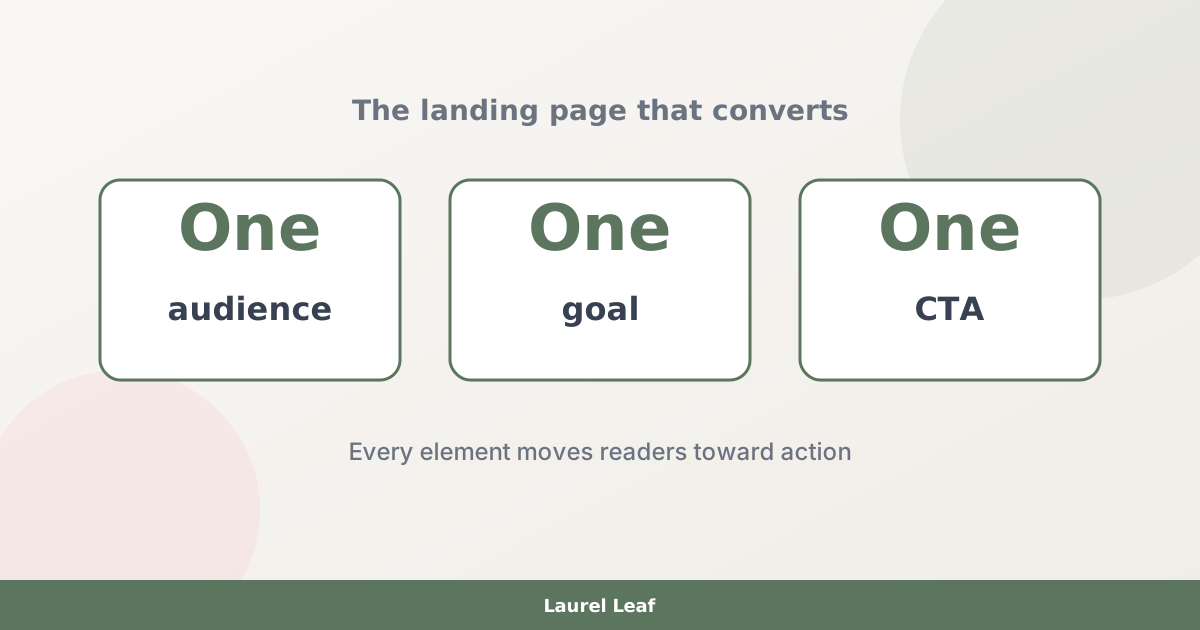
Which attributes describe a good landing page experience? Focus on one audience, one goal, and one CTA—every element should move your reader closer to that action. The key attributes that describe a good landing page experience include matching visitor intent, being specific rather than vague, using proof (data, testimonials, recognizable clients) to earn trust, and testing headlines, CTAs, and visuals one variable at a time until clarity wins.
Which attributes describe a good landing page experience?
The attributes that describe a good landing page experience are clarity, specificity, and focus on one goal. A good landing page matches your visitor's intent, explains how you help, shows proof, and guides them toward a single call-to-action—without distractions.
When I ask people how they write their landing pages, most say something like:
"I found a template online, dropped my copy in, and hoped it would work."
And that's where things go wrong.
After writing and reviewing hundreds of landing pages for SaaS, AI, and service-based companies, one thing is obvious: Writing a landing page that sells has very little to do with filling out a template. It starts long before you write a single word.
Why most landing pages don't convert
A landing page fails for the same reason most sales calls do: the prospect still doesn't get it. They might understand what you do, but they're still unsure:
- Is this for me?
- Will this work for my situation?
- Why should I trust you?
A strong landing page answers those questions before your reader even has to ask them.
💡 The Magic Moment
When someone lands on your page and thinks, "wow, this feels like it was written for me," that's when you know your messaging is doing the heavy lifting.
The real work happens before you write
The biggest difference between landing pages that work and the ones that flop isn't clever wording or fancy design—it's the process.
Here's how I think about it:
1. Start with your Ideal Customer Profile (ICP)
Who are they? What's going on in their world that makes your product or service matter right now?
2. Talk to them
Don't guess. Ask what frustrates them, what they've tried, what's fallen short. Real copy lives in those sentences.
3. Build your positioning strategy and message map
This is your North Star—the story that ties everything together. It helps you stay consistent across your landing page, emails, and LinkedIn posts.
Once you've done that, the writing becomes almost effortless. Because by then, you're not writing to your audience—you're writing from their perspective.
How to structure a landing page
A clear landing page follows the same logic as your buyer's thought process: Problem → Solution → Proof → Action.
Here's a simple structure to follow:
1. Hero
State the promise and who it's for.
2. Pain
Explain why that promise matters right now.
3. Solution
Show how your product or service solves it.
4. Proof
Add credibility—testimonials, results, recognizable clients.
5. CTA
Tell them exactly what to do next.
Each section should naturally answer the question raised by the previous one. By the time someone reaches your call-to-action, every doubt should already be resolved.
How to write landing page copy that converts
Landing page copy should lead readers from understanding to action. Start with problems, then tie them to your solutions, and then the outcomes your solution provides.
In your audience's language.
💡 Tips to Keep Your Copy Sharp
- • Replace abstractions with specifics. "Cut reporting time by 50%" beats "Save time."
- • Match your reader's vocabulary. If your buyers use technical language, mirror it.
- • Use testimonials and data points to show—not tell—your value.
- • Avoid overexplaining. Give just enough information to make the next step obvious.
Write for rhythm, not just readability. Short sentences. Clean transitions. Every line should earn the next click.
Landing page examples that convert
Check out these real-world examples of clients we've helped:
🚀 Real Results
ScalixAI Homepage
Within two weeks of launch, 32 calls booked with ideal ICPs—because the headline spoke directly to founders' growth pains.
Vanilla Steel Landing Page
3x conversion uplift by rewriting for buyer objections ("Can I trust this counterparty?") instead of product specs.
The truth about jargon
People always say, "Don't use jargon." But that's only half right. If your audience uses technical language, use it too—that's how they know you understand them.
The real enemy isn't jargon. It's abstraction.
Phrases like "unlock your potential" or "drive meaningful outcomes" sound nice, but they mean nothing. Be specific. "Increase qualified demo bookings by 30%" will always hit harder.
How to improve your landing page over time (A/B testing basics)
Change one thing at a time. Test your headline, CTA placement, or testimonial order.
Start with questions like:
- Which headline draws the most clicks?
- Does a visual testimonial convert better than text?
- How does button color or placement affect engagement?
Track clear metrics: conversion rate, click-through rate, scroll depth. Every test gives you a data point for refinement.
Landing page vs homepage: What's the difference?
Homepage
A navigation hub—it introduces your brand and directs people to explore.
Landing Page
Has one goal, one audience, and one action. It exists to convert.
If you have multiple audiences or offers, create dedicated landing pages for each. You'll get sharper messaging and better data on what works.
How to create urgency without FOMO
Urgency doesn't require fake scarcity or pressure tactics. You can build momentum ethically by highlighting opportunity and timing.
Instead of "Offer expires soon," say:
"Start now to shorten your sales cycle by a month."
It creates relevance without fear—and keeps your brand trustworthy.
Can you use testimonials from older offers?
Absolutely. Testimonials validate you, not just one version of your service.
Ask past clients if you can reuse or lightly edit their feedback for your updated offer. Or invite them to test your new package in exchange for an updated quote. Either way, real voices build trust faster than claims.
Quick checklist for a high-converting landing page
- ☑ One audience, one offer, one CTA.
- ☑ Headline = clear promise, not clever wordplay.
- ☑ Each section answers a specific buyer question.
- ☑ Real proof—testimonials, data, outcomes.
- ☑ Mobile-first design with visible CTAs.
- ☑ Test one variable at a time.
Final takeaway
A landing page is more than a story. It's a sales tool. Start with your audience's pain, clarify your promise, and make the path to action friction-free.
When structure, messaging, and intent all align, conversion follows naturally.
💡 Remember
Great landing pages don't convince. They clarify what's already true for the right audience.
Want a landing page with all the attributes that describe a good landing page experience? We'll help you map your message, write the copy, and publish it.
Reach out to our teamFrequently Asked Questions

Caitlin McCarthy
Messaging and Content Strategist at Laurel Leaf