


B2B marketers are under more pressure than ever to prove their content drives revenue. With AI Overviews and LLMs swallowing top-of-funnel visibility, zero-click searches are quickly becoming the new norm. In fact, a 2024 search study reveals that nearly 60% of Google searches end without a single click.
This shift has made bottom-of-funnel (BOFU) content more important than ever. It’s where click-through-rates are at their highest and content has the best chance of driving qualified leads.
But creating top-performing BOFU content is harder than most people think. It requires a deep and nuanced understanding of both who and what your product is for, and takes dedicated effort and planning to do right.
In this article we’ll take you through the most common traps we see teams fall into when setting strategy and executing BOFU content. You’ll learn:
- How to explain BOFU content to non-marketing teams
- Why qualified conversions (not traffic) should be your north star
- Why a customer-focused narrative is way more impactful
- The top mistakes we see when writing BOFU content (+ how to fix them)
At Laurel Leaf, we’ve helped hundreds of early-stage to Series B startups clarify their messaging and build repeatable content systems that make an impact. If you’re ready to nail content strategy, you know where to find us.
How To Create A Shared Understanding of BOFU Content
Before you start shaping your BOFU strategy, it’s important to clarify what it actually means to GTM teams. The terms BOFU, MOFU, TOFU mean very little outside of marketing. So before we dive into the nitty gritty, let’s talk about how to create a shared understanding of BOFU content, so everyone can get on board.
Simple translation: BOFU content = high intent content.
BOFU content is created for people in the final stages of finding a solution, when they’re comparing options and shortlisting suppliers. It exists to help in-market buyers clarify objections, understand if your product fits their specific needs, and prove that it delivers before they take the leap to talk to sales.
The content you’re creating can (and should) double as sales-enablement by giving reps the information they need to close deals. When done right, this BOFU lives far beyond a one-off blog or landing page. It’s actively used by sales to shorten cycles, handle objections, and provide value to potential customers.
Think of BOFU as an extension of your best Sales Engineer or SME. It guides prospects to the right information, addresses tough questions, and shows exactly how your product makes an impact.
Brooklin Nash, Co-founder of Beam Content, explains the close connection between BOFU and sales enablement content:
“Often marketing teams don’t realize the deep dive work that sales enablement and sales engineering are already doing and the foundation that can have for the content they’re creating.”
When you reframe BOFU as ‘high-intent’, it’s easier for every team to understand who this content is for and why it’s important. It also shifts ownership, taking BOFU content from a “marketing deliverable” to a shared company effort aimed at moving motivated buyers to talk to sales.
In order to create truly effective BOFU content you’ll need to get Product, CS, and Sales on board. This starts with a brand messaging framework that gives everyone a shared language for talking about your product and its value.
Conversions Are the North Star For BOFU Content
Another area where we see BOFU content break down is when marketers approach it with the wrong goal in mind. Firing off keyword-stuffed case studies and surface-level comparison pages might help you rank with SEO, but it won’t convince people to buy.
BOFU content isn’t designed to drive traffic. It’s designed to convert customers.
If your north star is traffic, you’ll optimize for clicks. But if your goal is conversion, you’ll optimize for customers. And guess what? By providing genuinely useful information that helps people solve a problem or make a decision, you’ll probably end up ranking anyways.
As Content Strategist and founder of Authority Plug Lashay Lewis puts it:
“If you write for the customer first, you have a really good chance of ranking. I mean you can rank all you want, but if you’re not converting, what does it really mean? What results are you really getting for the company?”
If you measure success by how well your BOFU content converts, you’ll naturally orient around providing the answers, use cases, and proof that customers are looking for in the final stages of their buying journey.
Frame Everything In the Context Of Your Customers
High-converting BOFU content doesn’t shout about features or cherry-pick results. It speaks to the experience of your customers: the frustrations, trade-offs, benefits, and risks they’re grappling with during the buying process.
Good BOFU content isn’t about making your product look good, it’s about making your customers feel heard.
This requires a clear point of view that connects your product to customer reality, showing how you see and solve their problems differently. It builds trust by painting your customer as the hero and providing truly useful information to help them make a decision.
If your BOFU assets read like spec sheets full of “we do this” and “our product that,” it might be time to reframe your strategy. Lee Densmer captures the difference between centering the product vs. centering the customer perfectly:
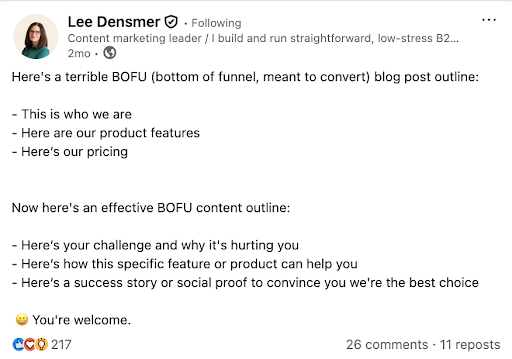
The purpose of BOFU content is to make it easier for buyers to picture themselves succeeding with your solution. The more specific and relatable your story, the stronger that picture becomes.
Top Mistakes We See Teams Make When Creating BOFU Content
Between internal silos, shifting priorities, and unclear ownership, even experienced teams end up producing BOFU content that falls flat.
Building helpful, conversion-worthy pieces takes more than splashy copy and killer keyword strategy. It requires alignment, planning, and buy-in across your entire GTM org.
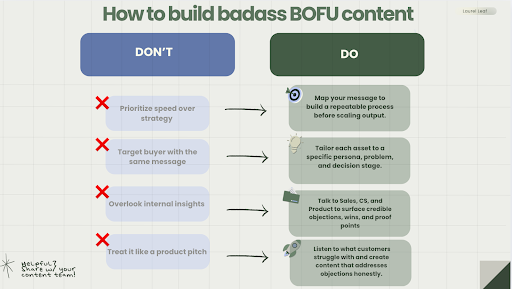
Here are the four pitfalls we see most often when executing this type of content, and how to fix them.
(If you want to build a system that helps you avoid these challenges altogether, check out our framework for BOFU Content Best Practices.)
1. Prioritizing Speed Over Strategy
With AI tools making content creation faster than ever, marketers can mistake motion for momentum. Shipping ten ‘you vs. [competitor]’ blogs this month might feel productive, but if they lack genuine depth and specificity you won’t get the results you’re looking for.
When output becomes the goal, you’ll end up with random acts of content—lots of motion with little impact.
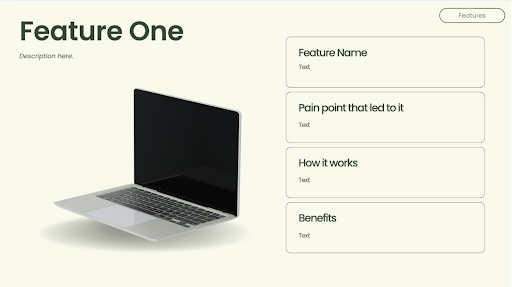
The fix: Slow down and figure out who your best-fit customers are, what they care about, and why they choose you. Our Message Mapping framework helps you map personas, pain points, and differentiators to product capabilities, giving you the foundation to build BOFU content that speaks directly to your customers and handles objections like a seasoned sales pro.
Here’s an example of how our Message Mapping framework connects customer context to feature capabilities:
2. Targeting Every Buyer With The Same Message
Not every buyer purchases your product for the same reason, so your BOFU content shouldn’t tell the same story. Speaking to all audiences at once blurs your message, weakens your position, and leaves you with a list of vague claims that probably apply to every other SaaS company.
If you try to be the best at everything, you’ll be remembered for nothing. Pick the lane that matters most to your audience, and stick to it.
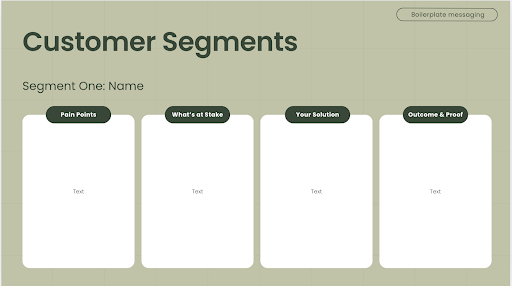
The fix: Get specific before you create. Define exactly which audience the asset is for and what action you want them to take. Build a brief by linking key features to real pains and tangible benefits. Don’t forget to tailor your CTA to match the natural next step in the buyer journey, whether that’s booking a demo or sharing a customer story.
This is where targeting verticals and sharing use cases helps you get granular when explaining the product and build credibility around specific solutions. Here’s how we help our clients create messaging that resonates across different customer segments:
3. Overlooking Internal Insights
The fastest way to improve your BOFU content? Break out of the marketing bubble. According to the Content Marketing Institute’s most recent research, 65% of the most effective B2B teams attribute their success to content relevance and quality. That level of specificity only comes from close collaboration with Product, Sales, and CS.
Your most persuasive angles and proof points aren’t hiding in competitor research or content brainstorms. They’re in sales calls, customer success updates, and Slack threads where your team is uncovering objections, wins, and “aha” moments.
As Lashay Lewis puts it:
“To create good bottom-of-funnel content, you need input from every team. You need input from CS, from product, from sales. But the problem is, a lot of companies have siloed communication internally.”
The fix: Build internal alignment into your content process. Create a shared Slack channel and schedule regular interviews with Sales, CS, and Product to surface patterns, quotes, and stories from real customer conversations.
Lashay Lewis has helpful venn diagram she uses at Authority Plug that covers the essential questions to ask each team:
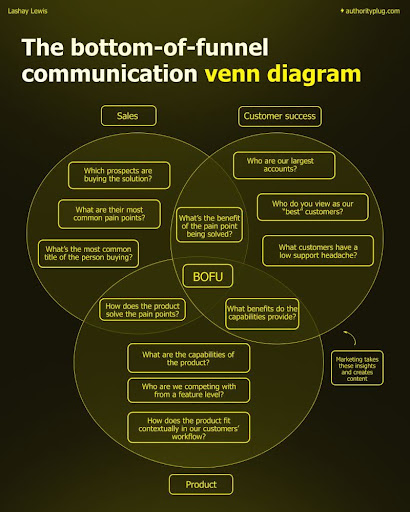
These insights will help you shape a point of view your competitors can’t copy, because it’s rooted in your own customer experience. BOFU content rooted in firsthand insights will always outperform content built on assumptions.
4. Treating BOFU Content Like a Product Pitch
Here’s the simplest way to tell if your BOFU content is missing the mark: it reads like your product team wrote a sales deck. Packed with capabilities but lacking real customer context.
When you start pitching instead of helping, you lose credibility fast. Buyers don’t care why you think your product is the best SaaS tool on the market. They care about how you’re going to help them tackle their problem.
The best BOFU content is the unifying voice between Product and Sales. It goes beyond describing what your product does and shows how it makes life easier, faster, or better for the people using it.
The fix: Talk less about your product and more about your customer’s reality. Listen to what they’re struggling with and create content that addresses objections honestly. Write transparent product comparisons that show trade-offs rather than hiding them. Be specific about what you do, how you do it, and why it matters.
Why BOFU Content Is Your New Growth Lever
The high-traffic SEO strategy that once powered most B2B pipelines is fading fast. Your awareness content might still rank, but it’s not filling your funnel with qualified leads anymore. That’s why BOFU content is so hot right now. It’s the type of content people still click on when they’re evaluating options and shortlisting solutions.
When you invest in creating great BOFU content, you also build alignment across Sales, Product, and CS. Beyond just creating one-off assets, you’re giving your GTM team a shared story that connects your product to the people it’s built for.
At Laurel Leaf, we help B2B SaaS teams get clear on what they do and who they’re for. If you’re ready to bring in the content marketing experts, let’s talk.