


Most B2B marketing teams are busy. The calendar’s packed, assets are shipping, and everyone’s working on five things at once. But are you all running in the same direction?

Our B2B content marketing strategy checklist gives you a systematic approach to building a foundation that supports your GTM motion. It’s designed for marketing leaders at B2B SaaS, AI, and tech companies who need a content engine that supports long sales cycles and drives measurable pipeline impact.
Without a documented B2B content marketing strategy, everything from ideation to reporting becomes much harder. And in complex B2B industries where sales cycles can stretch on for months, this misalignment can be the difference between ‘deal lost’ and ‘deal won’.
Here are the key questions we’ll help you answer:
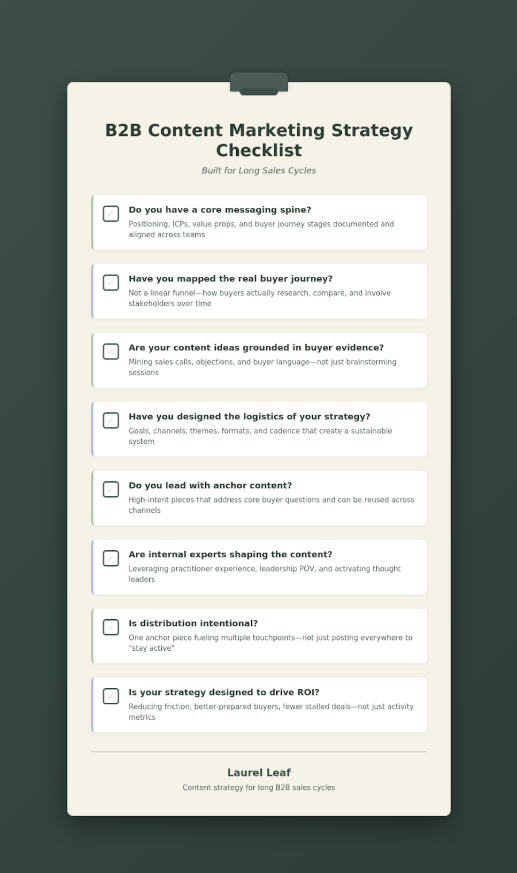
Let’s dive in.
Step 1 of every B2B content marketing strategy checklist: Do you have a core messaging spine?
No B2B content marketing strategy checklist would be complete without this step. Because without a shared narrative, marketing, sales, and leadership are all telling a different story. Your website says one thing, sales decks say another, and buyers are getting mixed signals at every touchpoint. This kills customer trust faster than anything else.
A core messaging framework creates a single source of truth that defines:
- Positioning and narrative: How you frame the problem and your unique approach to solving it.
- ICPs and buying committees: Who’s involved in buying decisions and what does each person care about.
- Value propositions: Why buyers should choose you over alternatives.
- Proof points: Evidence that backs up your claims in the form of testimonials, case studies, and first-party data.
- Buyer journey stages: What questions are buyers asking at each stage (Discovery → Evaluation → Decision).
Misaligned messaging doesn’t just confuse buyers. It fragments your team’s efforts. A single source of truth helps GTM teams move faster, reduce friction, and keep communication consistent across every channel.
Checklist:
- Audit team alignment by asking three different people the same question: “Who is our content for and what problem does it solve?” If you get three different answers, messaging documentation should be your first priority.
- Document your positioning, ICPs, value props, proof points, and buyer journey in a single shared framework your entire GTM team can access.
- Create a one-page message map that everyone—from product to sales to content—can use when creating any customer-facing asset.
Looking for a templated approach? Our Message Map framework consolidates all these elements into one sheet.
Step 2: Have you mapped your actual buyer journey (not just your funnel)?
The average B2B sales cycle takes 102 days from initial contact to closing. During that time, prospects consume several pieces of content, involve multiple stakeholders, and juggle shifting priorities and internal directives.
Traditional funnel thinking fails here. It assumes buyers move neatly from stage to stage. But in reality, your CISO is asking “how does this work with our stack?”, your CFO is asking “what’s the TCO and payback logic?” and RevOps wants to know “how long will this take to implement?”
Content mapped to the buyer journey answers the specific questions each stakeholder asks at each stage. It’s not about selling your solution, it’s about helping teams make the best decision with bottom-of-funnel content that supports evaluation.
Checklist:
- Map content to three critical questions: What triggers prospects to research (problem aware)? Who and what do they compare you against (solution aware)? What risks or objections reduce confidence in your solution (product aware)?
- Identify the stakeholders involved in buying decisions and document what each role cares about most (e.g., security = integration risks, finance = ROI proof, operations = implementation timeline).
- Before creating content, ask yourself: Does this piece answer a specific buyer question at a specific stage, or is it generic fluff that doesn’t help anyone decide?
Step 3: Are your content ideas rooted in buyer evidence?
Great content doesn’t come from brainstorming alone. Your strongest topics are based on actual customer conversations, not just broad assumptions.
Here are three sources of buyer truth that will help you uncover what information they actually need:
- Sales calls and deal reviews: What questions come up in every demo? What objections stall deals? What comparisons do buyers ask about repeatedly?
- Actual buyer language: How do prospects describe their problem when they search or ask LLMs? What terminology do they use internally?
- High-performing content: What assets did sales share that helped close? What blog posts do ideal customers reference in conversations? What company or employee LinkedIn posts are gaining traction?
If your content isn’t shaped by real buyer questions, it won’t support evaluation. And it won’t show up in search or LLM-driven discovery either.
Checklist:
- Review the last 10 sales calls or deal reviews and extract the top five repeated questions or objections prospects raise.
- Ask your sales team: “What questions do buyers ask that we don’t have good answers for?” Create content that answers those questions.
- Audit your content calendar. How many topics are backed by actual buyer evidence versus assumptions or trending keywords?
Step 4: Have you clarified the logistics of your content strategy?
Recent research done by The Content Marketing Institute found that 58% of B2B marketers rate their content strategy as only ‘moderately effective’, citing a lack of clear goals as the main reason they didn’t rank it higher.
Without clear goals, channels, themes, and cadence, content becomes random activity instead of strategic execution. This is where most teams skip ahead too fast. Speed creates weak briefs, scattered priorities, and rework.
Before you write a single word, clarify your content logistics by answering these questions (we follow Lee Densmer’s 3×5 framework) :
- Define your goals: What is content supposed to do this quarter? Support pipeline? Enable sales? Build category authority? Shorten buying cycles? You can’t optimize for everything at once, so pick up to 3 primary goals to focus on.
- Identify core channels: Where do your buyers spend time during evaluation? Search? LinkedIn? Email? Reddit? Niche communities? Prioritize the top 3 channels where your ICP actually makes decisions.
- Align on core themes: What problems do buyers need repeated reassurance on? What comparisons keep surfacing? What misconceptions stall deals? Build 3 content pillars around these themes rather than diluting your efforts over 10+ different topics.
- Set formats and cadence: What’s sustainable for your team’s bandwidth? Blogs, guides, case studies, video interviews? Weekly, bi-weekly, monthly? Consistency beats volume every time.
Checklist:
- Prioritize 3 content goals for this quarter and communicate it to everyone involved in content creation.
- Identify the 3 channels where your ICP spends time evaluating solutions and focus distribution there first.
- Define 3 core content themes based on repeated buyer questions and objections, not just trending topics.
- Establish a realistic content cadence your team can maintain for 90 days without burning out.
Step 5: Do you lead with anchor content?
Instead of chasing volume on every channel, start with one strong, high-intent anchor piece that answers a core buyer question. Then redistribute that content across your core channels.
Anchor content is designed to:
- Address questions buyers ask when they’re evaluating solutions
- Take a clear position on a problem your ICP faces
- Have enough depth to be reused across multiple channels and formats
The difference between anchor content and generic blog posts is intent and leverage. Generic content hopes someone finds it useful. Anchor content is built around a specific question buyers ask when comparing solutions—then repurposed into social posts, email sequences, sales enablement, and more.
If SEO is part of your strategy, validate anchor topics against keywords buyers actually search for, including how they prompt LLMs.
Checklist:
- Identify one high-intent topic your buyers search for when actively evaluating solutions (not just learning about the problem).
- Validate the topic against actual buyer search behavior—check what prospects ask during sales calls and what keywords they use in search or LLMs.
- Build your first anchor piece around this topic, then plan how to repurpose it into 5-7 additional assets before moving to the next topic.
Step 6: Are internal experts shaping your content and are you activating thought leaders?
The best B2B content comes from real practitioner experience and POV-driven content. Internal subject matter experts hold insights your buyers trust and competitors can’t replicate, but only if you extract and activate them properly.
Two critical elements here:
- Internal SMEs provide unique insights: Product leaders know the technical nuances competitors miss. Customer success teams hear objections sales doesn’t. Engineering understands implementation challenges buyers worry about. These insights differentiate your content from AI-generated generic advice.
- Thought leaders extend reach and trust: Buyers want to do business with people, not corporate entities. Activating founders, executives, or senior practitioners on LinkedIn amplifies your message beyond what brand-only distribution can achieve.
This is how you create true ‘thought leadership’. Not only are you demonstrating a deep understanding of your customers’ issues, but you’re also fortifying your content with the expertise and authority search engines and LLMs are ranking for.
Checklist:
- Identify 2-3 internal subject matter experts who can provide unique insights on topics your buyers care about.
- Record SME interviews or extract insights from sales debriefs, product documentation, and leadership conversations to fuel content creation.
- Activate at least one thought leader (founder, executive, or senior practitioner) to share content from their personal LinkedIn account, not just the company page.
- Repurpose expert insights across blogs, sales enablement, LinkedIn posts, and webinars to maximize leverage.
Step 7: Is distribution intentional (not just frequent)?
Publishing once and hoping it works is the classic content mistake. One strong piece should fuel multiple touchpoints across channels where decisions actually happen.
Distribution with intent means designing a system where one anchor piece reinforces the same story across the buyer journey—from blog content and landing pages that support evaluation to sales enablement.
Your distribution plan should include:
- Multi-channel deployment: Your piece feeds website/SEO, email, LinkedIn (personal + brand), sales enablement, paid promotion, and partner channels
- Strategic gating: Only extremely valuable pieces (calculators, templates, deep research) go behind forms. Educational content stays open to build trust.
- Usage tracking: You monitor what sales teams actually share in deals and which pieces buyers engage with most
- Content refresh cycles: Review and update high-performing assets every 6 months to extend their value
If you’re posting everywhere “just to stay active,” you’re leaving leverage on the table.
Checklist:
- For every anchor piece, plan distribution across at least 3 channels mand maintain a content calendar showing when and where each repurposed asset will be shared.
- Only gate content that provides immediate, tangible value (calculators, templates, deep research), keep educational content ungated to build trust.
- Track which content sales teams actually use in deals and which pieces buyers engage with most, then double down on what works.
- Once an anchor piece is published, plan in a refresh at the 6 month mark to extend the lifespan of each high-value asset.
Step 8: Does your content strategy aim for ROI and not just activity?
When leadership asks “Is content helping revenue?” most teams respond with page views and engagement metrics. But content ROI comes from reducing friction in the buying process, not just increasing traffic.
A successful content strategy shows up in more informed buyers, less re-explanation, and faster time from evaluation to sale. Traditional content metrics like website traffic and post engagement fall short because they measure activity, not impact.
For complex B2B products the measurement gap is even bigger. Long sales cycles and multiple stakeholders make it hard to track the immediate impact of content.
Here’s what to track instead:
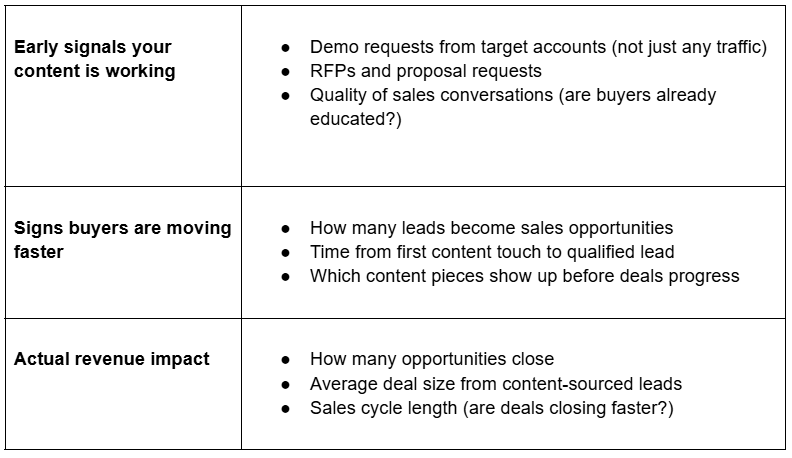
The goal isn’t more content. It’s content that moves deals forward.
Checklist:
- Define 3 metrics that show content is moving buyers through stages (not just generating traffic)—like SQL conversion rate, opportunity creation from content, or sales cycle length.
- Set up tracking for content-influenced pipeline: Which assets do buyers engage with before becoming opportunities?
- Ask your sales team monthly: “Which content helped move deals forward this month?” Track and double down on high-impact assets. You can even mine sales calls for mentions of content topics.
- Review metrics quarterly and adjust strategy based on what’s actually driving pipeline, not just what’s getting clicks.
What Changes When Your B2B Content Marketing Strategy Starts Working
A solid content strategy reduces friction for prospects and internal teams. It creates a shared narrative across channels, supports evaluation over time, and makes sales conversations easier.
When your content marketing strategy starts working you’ll see:
- Fewer stalled deals because buyers are better educated
- Higher-quality prospects entering the funnel
- Content reused across marketing, sales, and leadership without rework
- Faster sales cycles thanks to thought leadership and tighter messaging
Over time, a systems-led approach compounds. The same core insights fuel marketing, sales, and leadership communication. Content gets repurposed instead of created in silos. Sales conversations become more focused. Misaligned buyers self-select out. Teams spend less effort re-educating and more time advancing real opportunities.
That’s the difference between a content strategy and a content calendar. One drives revenue. The other just fills time slots.
Ready to put this B2B content marketing strategy checklist to practice?
Most teams we work with have smart people and content in motion… but sense that “this should be working better.” What’s missing is a connected system that aligns messaging, content, and sales around the same buyer reality.
At Laurel Leaf, we help B2B teams:
- Clarify messaging before scaling output
- Design content around real buyer questions
- Build a content engine that support long sales cycles