


For years, SaaS marketers have approached content with a strict funnel mindset and chased traffic like it was the only KPI that mattered. The logic was more traffic = more people entering your funnel = more sales once you pushed them to buy.
But that thinking doesn’t hold up anymore. Buyers don’t move neatly from awareness to decision. They jump in and out of the process based on timing, budget, and urgency.
According to the 95:5 rule by Professor John Dawes, only 5% of B2B buyers are actively in-market at any given time. The other 95% aren’t booking demos anytime soon. Supporting them with educational content still matters for awareness, but it won’t drive short-term pipeline.
With AI search tools and LLMs generating sufficient summaries for the majority top-of-funnel queries, most users find their answer without clicking through to a single site. As a result, the traditional TOFU playbook is losing impact, and broad awareness content has an even smaller chance of converting.
If you’re a SaaS or AI startup trying to influence immediate revenue, your best bet is to go hard on content that supports the 5% of customers that are ready to buy.
And you do that by creating bottom-of funnel (BOFU) content.
In this article will take you though:
- What BOFU content really means
- What good BOFU content looks like
- Some common BOFU content examples
- What happens when SaaS teams invest in BOFU content
- A step-by-step framework to create killer BOFU content (inspired by Lashay Lewis)
At Laurel Leaf, we’ve helped 100+ startups refine their messaging and build content systems that drive trust and authority. From tripling on-site conversions for AI startups like Autoblocks to re-positioning SaaS and AI brands, we’ve seen firsthand how customer-centric content pays off.
Let’s break down how you can do the same.
What does BOFU content really mean these days?
While the funnel framework may feel dated, it’s still a useful shorthand for understanding how to move buyers from awareness to action. The three stages of the buying journey include:
- Top-of-funnel (TOFU) where marketers create awareness for buyers who have identified the problem they need to solve.
- Middle-of-funnel (MOFU) where marketers help buyers consider solutions for solving their problem.
- Bottom-of-funnel (BOFU) where marketers help buyers decide what solution is the best fit to eliminate the problem.
BOFU content is designed to convert prospects into paying customers. It removes friction from the buying process by answering last-mile questions, addressing objections, and showing exactly how your product solves their specific problem.
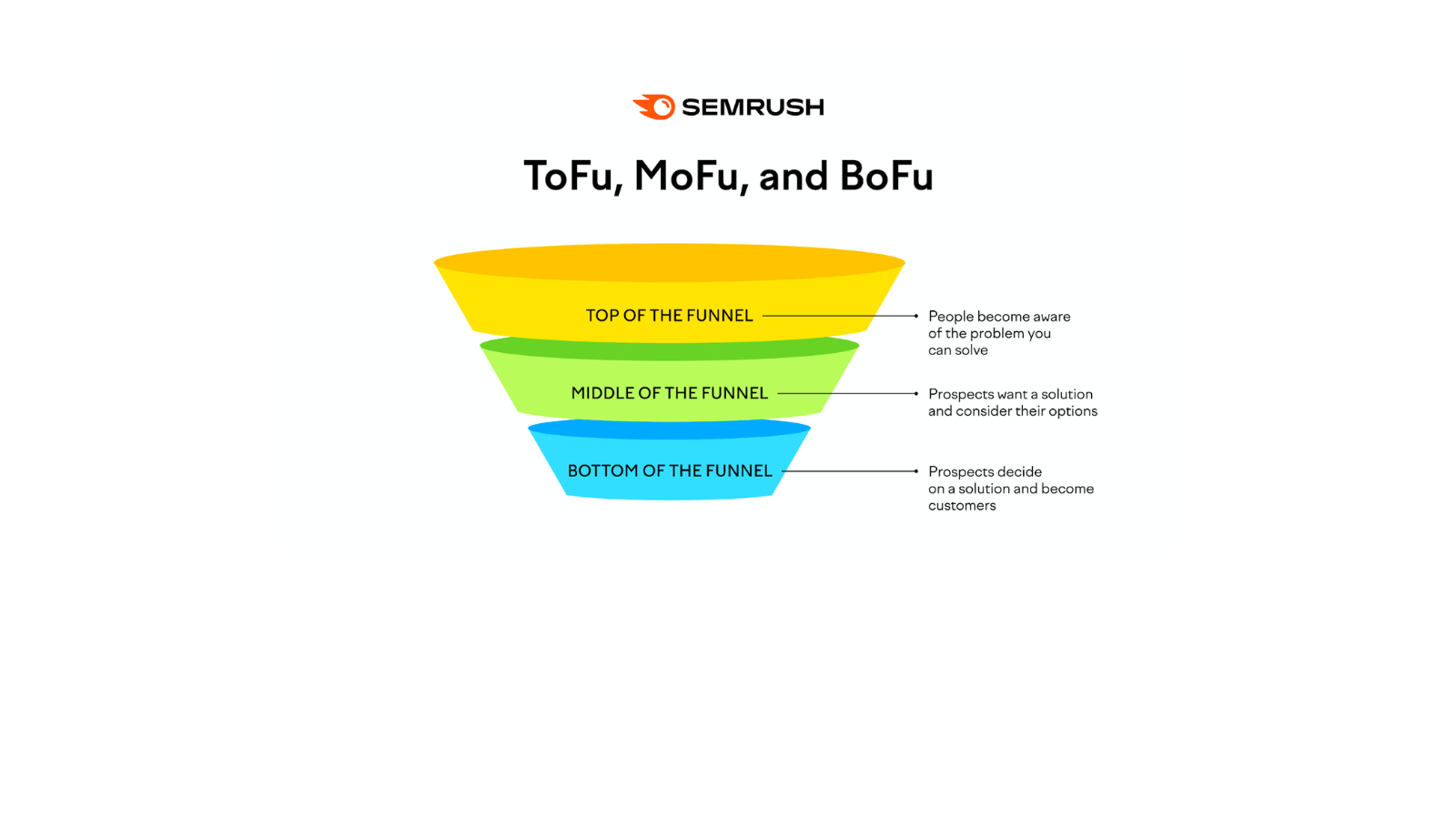
Image source: Semrush
However, the funnel shape can be misleading. It suggests BOFU is the smallest stage, but in reality it drives the largest share of revenue impact. While TOFU and MOFU efforts cast a wide net, BOFU content targets people who are actively comparing solutions right before they buy, it makes sense that this is the place to focus if you want to target that 5% of people ready to pull the trigger.
Marketers like Lee Densmer argue that it’s time to leave behind rigid ‘push-through-the-funnel’ thinking in favor of content that builds trust and clarity.
Her buyer-centric approach flips the funnel so content works less like a conveyor belt and more like a filter—attracting the right buyers while deterring the wrong ones.
In her book Content, Simplified, Lee explains how content should focus on helping in-market buyers understand how your product solves their problem:
“Make no assumptions that your buyers are going to read one content piece, then the next, then the next, in a linear way. Instead, simply focus on what questions they’re asking, the challenges they’re facing, and what their objections are, and the features of your solution that solve that problem.”
What does great BOFU content look like?
BOFU content sits at the intersection of sales enablement and storytelling. It connects your customers’ pains to your product’s capabilities in a way that feels helpful, not salesy.
As Tashina Fleming, Marketing & Content Consultant at Laurel Leaf, puts it:
“BOFU blogs shouldn’t be promotional. They need to be objective, unbiased views into the products.”
That’s because the goal of BOFU content isn’t to convince buyers that your product is the best. It’s to help them make the best decision for them. At this stage, buyers are looking for clarity, credibility, and proof, not marketing spin.
Good BOFU content succeeds when it:
- Represents your product honestly alongside competitors.
- Answers specific, high-intent questions like “Which tool is best for…?” “How does this compare to…?”.
- Uses real examples, data, and customer stories to back up claims.
- Acknowledges trade-offs and helps buyers assess product fit for themselves.
The goal of BOFU content isn’t to convince buyers you’re the best. It’s to make their decision so clear that choosing you feels inevitable.
What are some BOFU content examples?
BOFU content can take many forms—from blogs to demos to webinars. What makes it ‘BOFU’ is the intent behind it: help buyers make informed decisions when they’re closest to purchasing.
While top- and mid-funnel content focuses on education and awareness, BOFU assets are built to validate, differentiate, and convert. Here are some of the most effective BOFU content types we see SaaS teams use:
| Customer stories | Proof that your product creates impact through relatable results and customer testimonials. |
| Case studies | Focus on before/after, challenges solved, and measurable impact of your solution in specific industries. |
| Comparison pages | An honest look at how you differ from competitors, what the trade-offs are, and why that difference matters. |
| Tools & resources | Resources that help customers solve their problem themselves (calculators, checklists, templates.) |
| Product demo/pricing | Showcase your product in action by putting features in the context of customer pains. |
Why should B2B SaaS teams invest in BOFU content today?
Most educational or awareness content is great for starting conversations, but it needs a follow-up touch like an email, remarketing ad, or sales outreach to convert.
The beauty of BOFU content is that it’s designed to convert on its own by meeting buyers at the exact moment they’re ready to decide. It answers the questions they’re already asking, and gives them the validation they need to take the next step.
To get an idea of how much more effective BOFU content is, let’s take a look at how conversion rates stack up across the B2B content funnel:
| Funnel stage | Typical conversion rate (CVR) | Example content type |
| TOFU | 0.3–0.6% | Educational blog, how to guide, thought leadership |
| MOFU | 1–3% | Case study, gated content, industry report |
| BOFU | 5–10%+ | Competitor comparison, pricing page, customer testimonials |
While TOFU content converts >1% of visitors, BOFU content often hits 5–10% CVR and typically brings in more qualified leads. That’s because BOFU topics target high-intent buyers that are in-market for a solution, not just exploring ideas.
Despite the effectiveness of BOFU content, Lee Densmer observes that most marketing teams still spend most of their time creating top-of-funnel content. She suggests flipping content efforts to a more results-driven balance of 10% TOFU, 40% MOFU, and 50% BOFU:
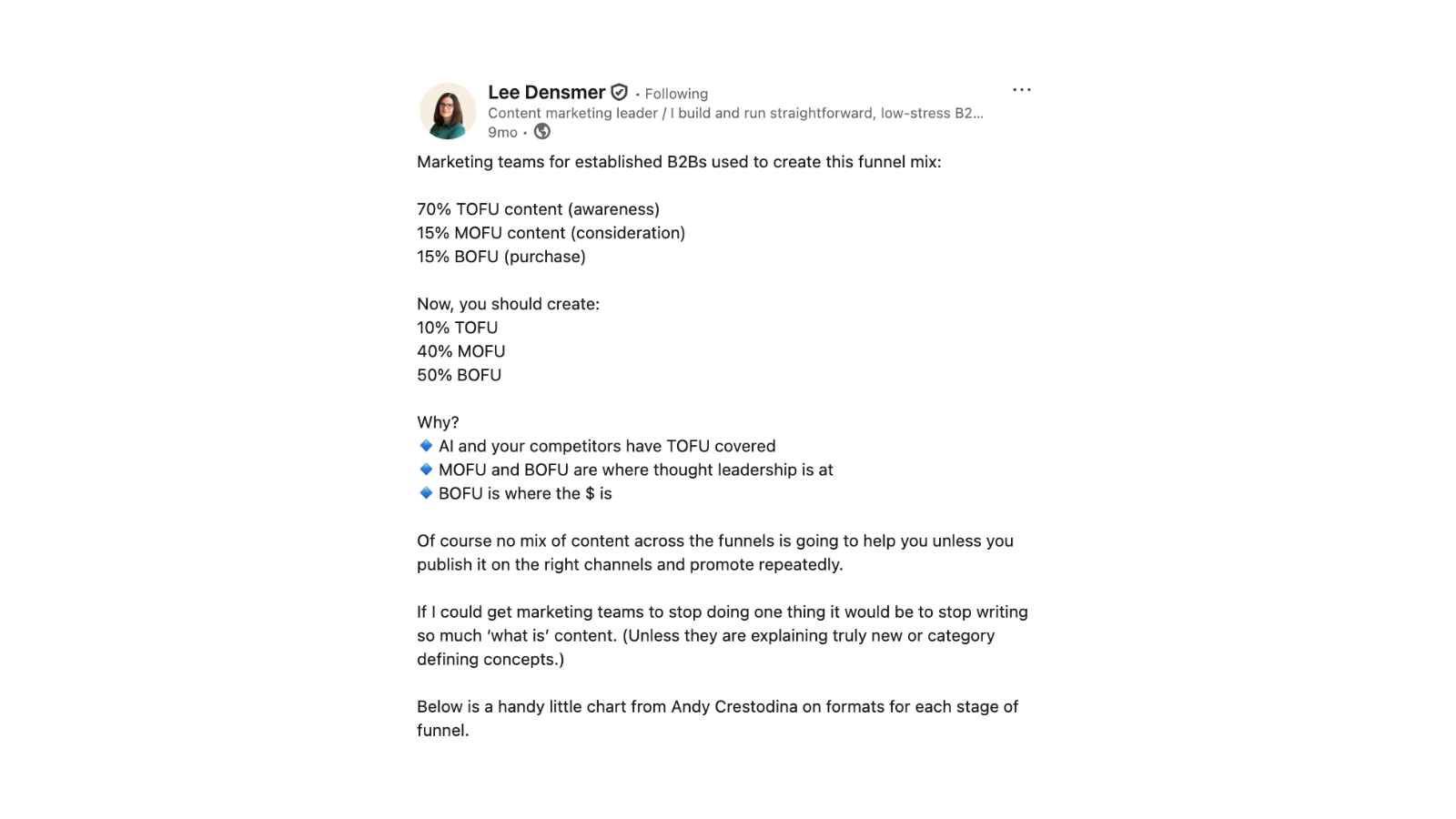
In short, if you want to directly impact revenue, directing your efforts to BOFU content will deliver the highest return.
How to create BOFU content that seals the deal
To help you create BOFU content that converts, we’ve combined our Message Mapping process with insights that BOFU expert Lashay Lewis recently shared in the Exit Five B2B marketing community.
Step 1: Start with a Message Map to understand your ICP
Message Mapping is an essential first step that most SaaS teams skip over. As our Founder, Defne Gencler, puts it:
“They assume they already know their ideal customer persona (ICP). But in reality they don’t have a true documented north star for how they should think and talk about their product, especially in relation to their customers.”
Below are a few sample slides from the framework Laurel Leaf uses to help clients understand who they serve, the high stakes problems their customers face, along with how and why their product solves them.
(You can download the full framework here.)
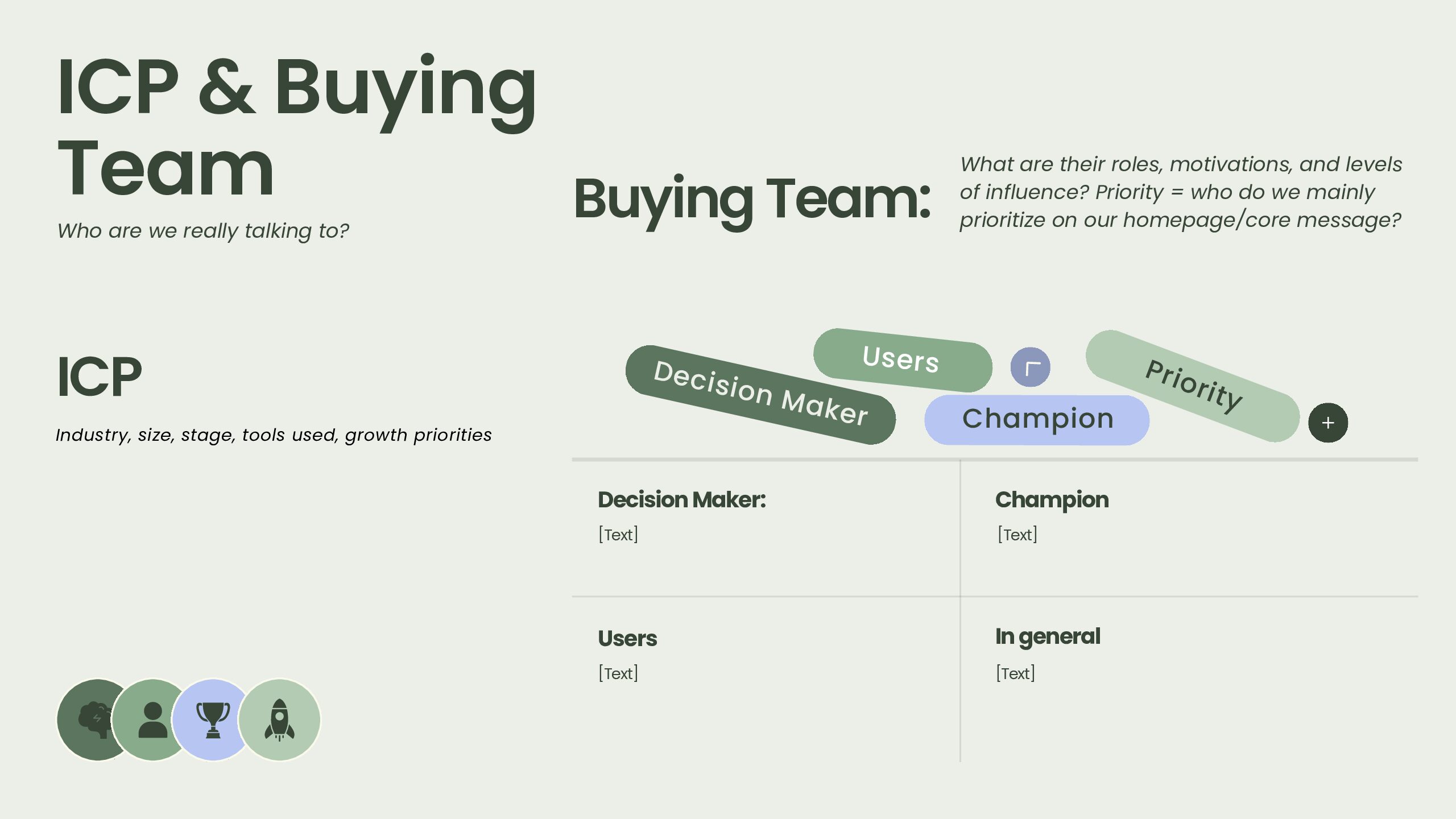
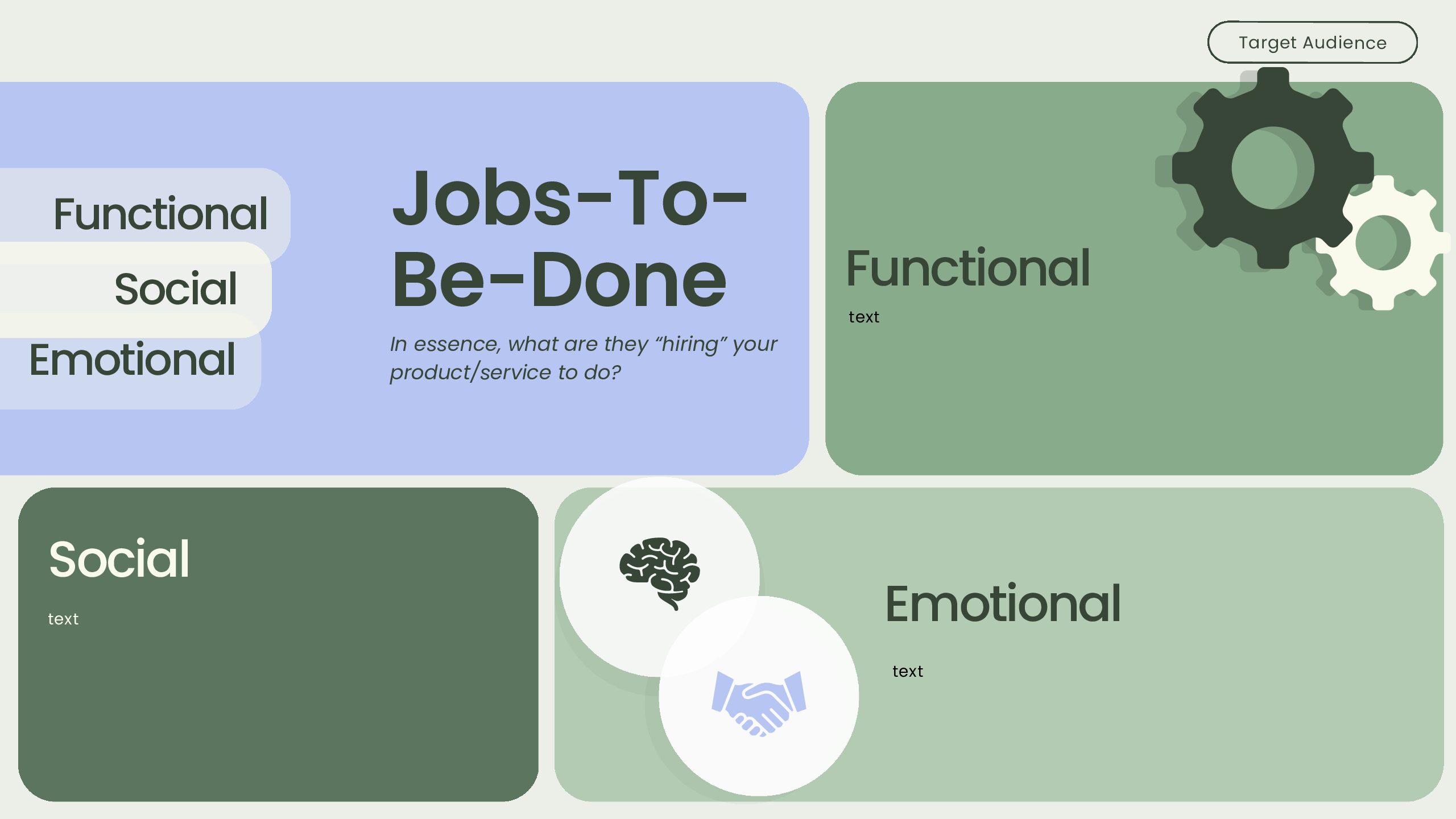
Don’t know how to fill the answers out? Stuck on where to start?
These insights probably already exist inside your company. They’re buried in sales calls, customer interviews, product documentation, and everyday conversations between your team and customers. Unearthing these will give you the foundation of your Message Map.
Step 2: Connect specific features to customer pains
Great BOFU content speaks directly to how your product solves real problems. To do that effectively you need to know which parts of the product matter most to which customers.
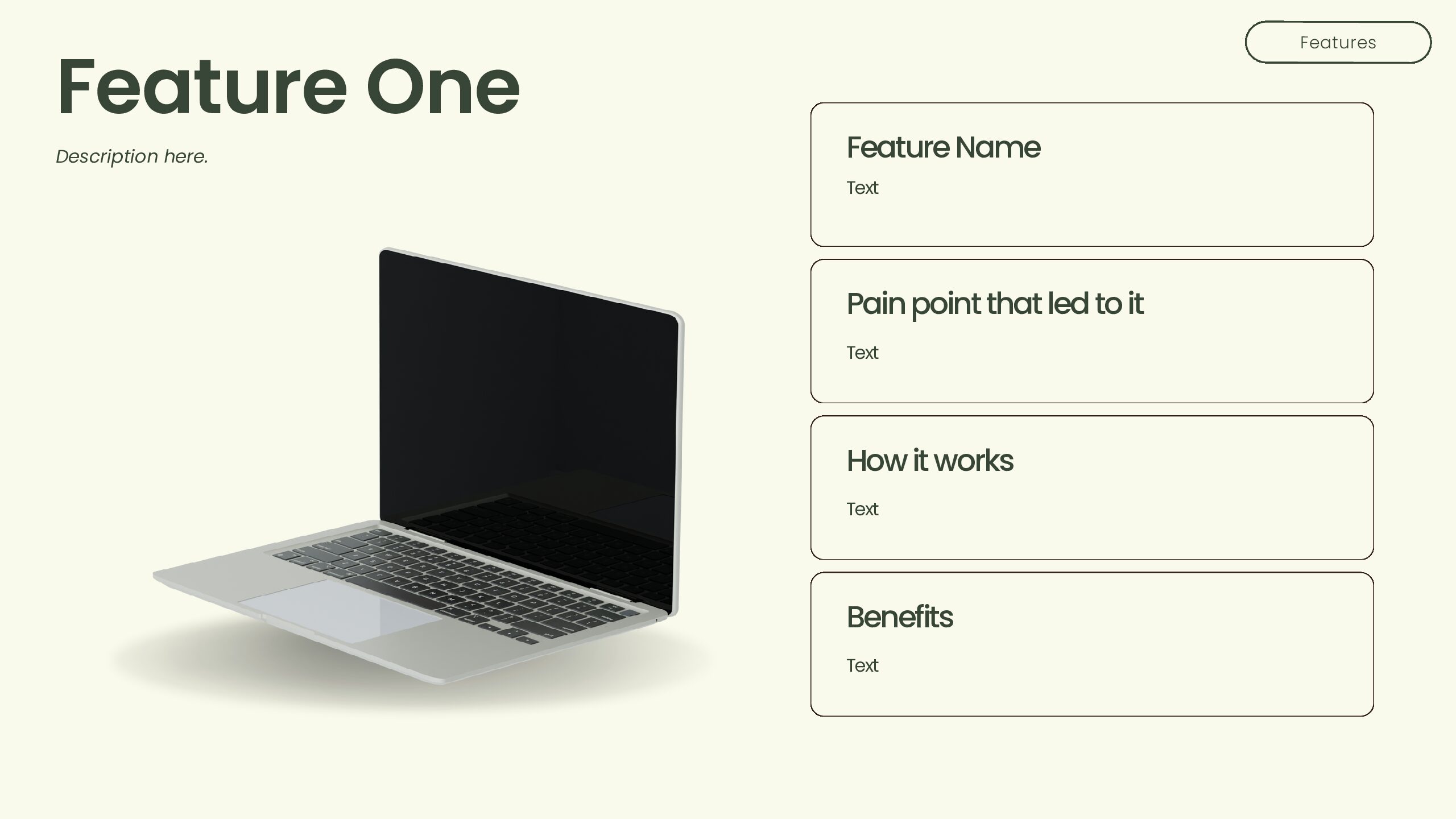
During our Message Mapping process, we help clients break their product down into individual features. Then we map each feature to the pains it solves, the capabilities it provides, and the outcome it enables.
This helps shift the framing of BOFU content, taking it from a laundry list of capabilities to the specific ways in which it solves problems for your ICPs.
Here’s an example of our framework:
Getting out of the marketing bubble is key to understanding how people actually use your product. Lashay Lewis highlights the importance of external input in uncovering what your product actually does:
“Good BOFU content needs input from every team. Those insights should then be baked into each piece you publish. Not just on your blog, but across every piece of collateral your team produces… In a perfect world, even before BOFU or TOFU, you’d have messaging. And that messaging would come from interviewing PM, sales, and customer success.”
If you’re creating content for a CRM feature that automates reporting, this step helps you go from generic blog titles like “The Benefits of Automated Reporting Tools” to titles that resonate and create urgency like “How to Stop Wasting 10 Hours a Week on Manual Reports.”
Going through the Message Mapping process sets your team up to create compelling BOFU content.
Step 3: Do keyword research last, not first
Instead of starting with keywords and forcing your product to fit them (so 2015), use your feature mapping and pain points to uncover search terms that reflect real buyer intent.
Once you’ve defined who cares about your product and what problem they’re trying to solve, you can identify the exact phrases your best fit customers use when they’re shortlisting solutions. This keeps every article, landing page, and case study grounded in buyer insight, not just SEO visibility.
Here’s what Lashay Lewis had to say about search visibility on the B2B Playbook podcast:
“I’ve never had a problem ranking because I’m focusing on the customer. It’s never a fight of, Ooh, should I make this SEO optimize or should I make it about the customer? It’s always going to be about the customer first.”
But remember, not all BOFU keywords carry the same level of intent. Even among ‘high-intent’ BOFU searches, conversion potential varies based on how essential your product is to business operations:
- For critical products like compliance, tax services, or legal tools, the intent to purchase is almost inevitable. Buyers are in need of an immediate solution and need to choose a solution one way or the other.
- For ‘nice-to-have’ products like creativity tools, learning platforms, or wellness apps, the intent is softer. These buyers are looking for a better way to do things, but will wait for the right product (and the right price) to come along before they buy.
Understanding this spectrum of intent helps you shape the right strategy. High-intent searches signal an immediate need and therefore a higher conversion potential. Lower-intent products reflect a desire to improve, but it’s not a must-have meaning buyers will need more convincing before converting.
High-intent categories can rely more on purchase-driven BOFU content (like comparison pages or pricing breakdowns) supported by paid search. Lower-intent categories benefit from a mix of MOFU and BOFU content across multiple touchpoints to educate prospects until they’re ready to buy.
Step 4: Build your BOFU content cluster
Once you’ve connected your features, pain points, and ICPs, it’s time to bring them together into a BOFU content cluster. This is a focused set of assets that support buyers at every stage of their buying decision.
Each piece plays a different but complementary role. Some assets speak to buyers researching competitor options, while others provide the social proof that your solution works for companies like them.
It’s important to remember that these pieces don’t exist in isolation. A buyer might first encounter a comparison page, then explore a customer story for proof, and finally engage with an interactive calculator to get the validation they need for executive approval.
Together, these touchpoints reinforce your message from multiple angles and make it easy for prospects to make a decision. Here’s an example of a well-rounded BOFU content cluster:
| Cluster | Example BOFU Asset | Purpose |
| Comparison pages | “Product A vs. Product B” | Captures evaluators in decision mode. |
| Use cases | “How Finance Teams Save 5 Hours Per Week By Automating Monthly Reports” | Proves industry credibility and signals value. |
| Customer Stories | “How [Customer] Cut Manual Work by 45% Using [Feature]” | Provides social proof and demonstrates benefits. |
| Interactive Resources | “Content ROI Calculator For Marketing Teams” | Drives engagement + lead generation. |
Every asset ties back to a specific feature + pain point + persona, giving you a scalable content system designed to convert.
Tap in to the power of BOFU content
When you put it all together, a strong BOFU strategy is designed to convert. For SaaS companies and brands with complex products, feature mapping helps you move beyond one-size-fits-all messaging and speak directly to what each customer cares about most.
The result? Fewer random acts of marketing, more qualified leads, and content that consistently drives measurable revenue impact.
At Laurel Leaf, we help SaaS and AI companies clarify messaging and build content systems that consistently convert more leads.